
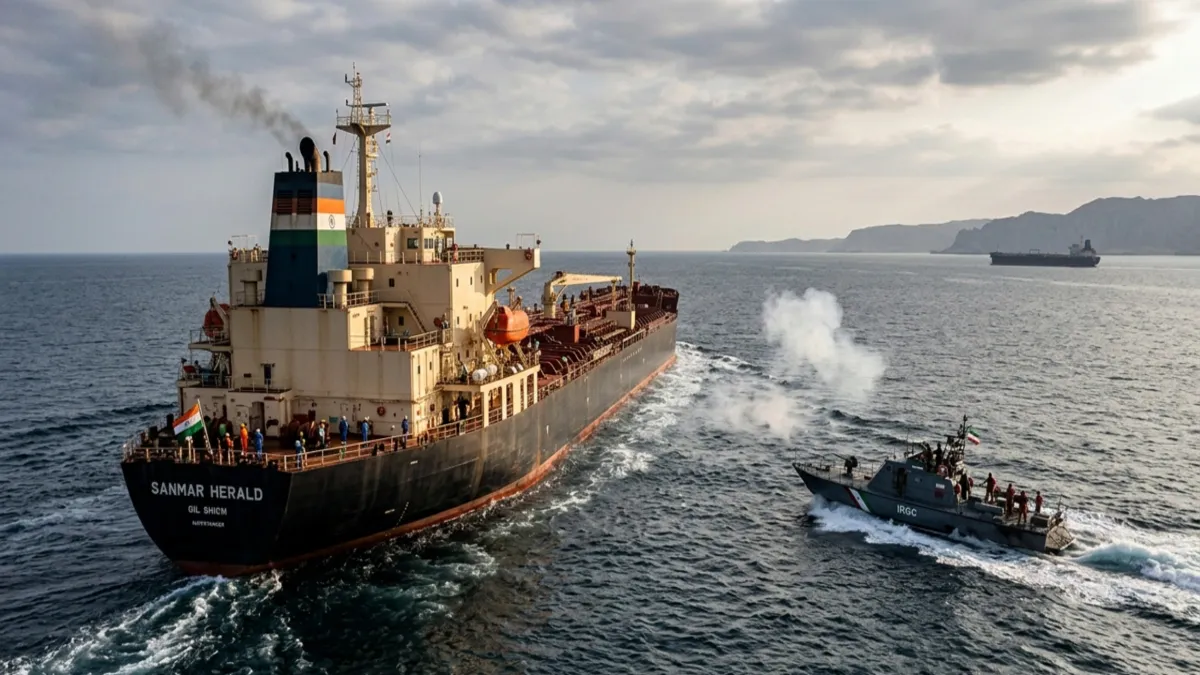
Strait of Hormuz escalation reached a critical flashpoint on Saturday, April 18, 2026, as Iranian IRGC gunboats opened fire on Indian-flagged merchant vessels attempting to navigate the world’s most vital maritime chokepoint. The incident, involving the oil supertanker Sanmar Herald and the bulk carrier Jag Arnav, has triggered a high-stakes diplomatic standoff.
New Delhi is now demanding “swift clarification” and an immediate end to the “reckless action” threatening global energy security.
A Violent Escalation: The IRGC Engagement
The confrontation erupted less than 24 hours after regional powers had signaled a temporary “opening” of the waterway. The Sanmar Herald, a Very Large Crude Carrier (VLCC) transporting nearly 200,000 tonnes of crude oil, and the Jag Arnav, carrying critical agricultural supplies, were intercepted by high-speed gunboats belonging to the Islamic Revolutionary Guard Corps (IRGC) Navy.
According to maritime security reports, the vessels were approached northeast of Oman without any standard VHF hailing or challenge. The IRGC units then discharged weapons toward the tankers. In a harrowing audio recording captured by maritime monitors, a bridge officer from the Sanmar Herald can be heard pleading with the Iranian patrol:
“You gave me clearance to go; you are firing now. Let me turn back.”
In an act of desperation to signal their civilian status and nationality, the Sanmar Herald reportedly updated its AIS (Automatic Identification System) signature to read “INDIANSHIPINDIANCREW” as it executed a tactical retreat from the danger zone.
New Delhi’s “Red Line” Diplomacy
The Indian government’s response was swift and uncharacteristically firm. The Ministry of External Affairs (MEA) summoned the Iranian Ambassador to New Delhi, Dr. Mohammad Fathali, to South Block on Saturday evening. India’s Foreign Secretary lodged a “strong protest,” conveying New Delhi’s “deep concern” over the safety of its innocent seafarers.
This diplomatic rebuke marks a significant shift in the India-Iran relationship. While New Delhi has traditionally maintained a policy of strategic autonomy in the region, the direct targeting of commercial shipping represents a definitive “red line.” The MEA underscored that the freedom of navigation in the Strait of Hormuz is non-negotiable and that civilian crews must not be used as leverage in regional brinkmanship.
The “Chokepoint” Crisis: Why the Strait is Stalled
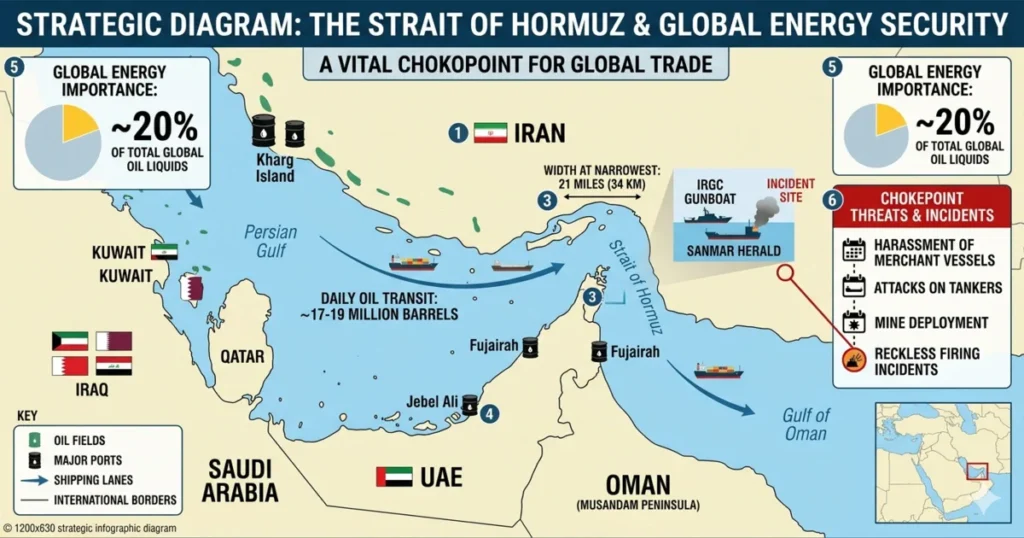
The incident highlights a chaotic breakdown in regional coordination. While some international reports suggested the Strait was “completely open” following a US-brokered window, the Iranian Armed Forces Headquarters countered that the waterway remains under “strict management.”
Iran appears to have reimposed these curbs in response to perceived failures in the lifting of regional blockades. This has left the Strait in a “previous state” of volatility, effectively trapping dozens of ships. Currently, three other major Indian tankers, the Desh Suraksha, Desh Vaibhav, and Desh Vibhor, remain stuck in the Persian Gulf, with some crews awaiting transit for over 45 days.
Global Impact: Oil Supply and Energy Security
The Strait of Hormuz is the world’s most vital energy chokepoint. Nearly 20% of global oil and a third of the world’s liquefied natural gas (LNG) pass through its 21-mile-wide passage. For India, the stakes are existential:
- Energy Dependence: India relies on the Gulf for over 60% of its crude oil requirements.
- Economic Ripple Effects: Any sustained disruption in the Strait sends immediate shocks to global Brent Crude prices and triggers a surge in maritime insurance premiums.
- Seafarer Safety: Thousands of Indian nationals serve on merchant vessels in these waters, making their protection a matter of national priority.
The Path to De-escalation
As the Indian Navy monitors the situation with destroyers and frigates currently deployed in the Gulf of Oman, the international community is calling for maximum restraint. The targeting of unarmed commercial ships is a clear violation of the United Nations Convention on the Law of the Sea (UNCLOS).
New Delhi’s firm stance serves as a reminder that, while it seeks regional peace, it will not tolerate endangering its citizens or its economic lifelines. As the world awaits a formal response from Tehran, the goal remains a return to safe, unimpeded transit. Without a clear commitment to de-escalate, the risk of a broader maritime conflict remains a looming threat to the global economy.
FAQs
Which ships were involved in the firing incident?
The primary targets were the Sanmar Herald (carrying 2 million barrels of oil) and the Jag Arnav (carrying urea). While the Sanmar Herald sustained minor damage (a broken window), both ships and their crews are confirmed safe.
Why did Iran open fire if the Strait was reportedly open?
There is a massive “fog of war” regarding the Strait’s status. While the US claimed the waterway was open following a ceasefire in Lebanon, the IRGC reimposed “strict management,” alleging US breaches of trust. The firing served as a violent reassertion of Iranian control.
What was the “INDIANSHIPINDIANCREW” signal?
In a desperate attempt to avoid further fire, the Sanmar Herald updated its AIS (Automatic Identification System) status to “INDIANSHIPINDIANCREW.” This was a manual plea to the IRGC to recognize them as a neutral, civilian Indian vessel rather than a hostile target.
How does this affect India’s energy security?
The Strait of Hormuz is India’s primary energy artery, supplying over 60% of its crude oil. Continued “reckless action” by the IRGC threatens to spike domestic fuel prices and skyrocket maritime insurance premiums, potentially destabilizing the Indian economy.