
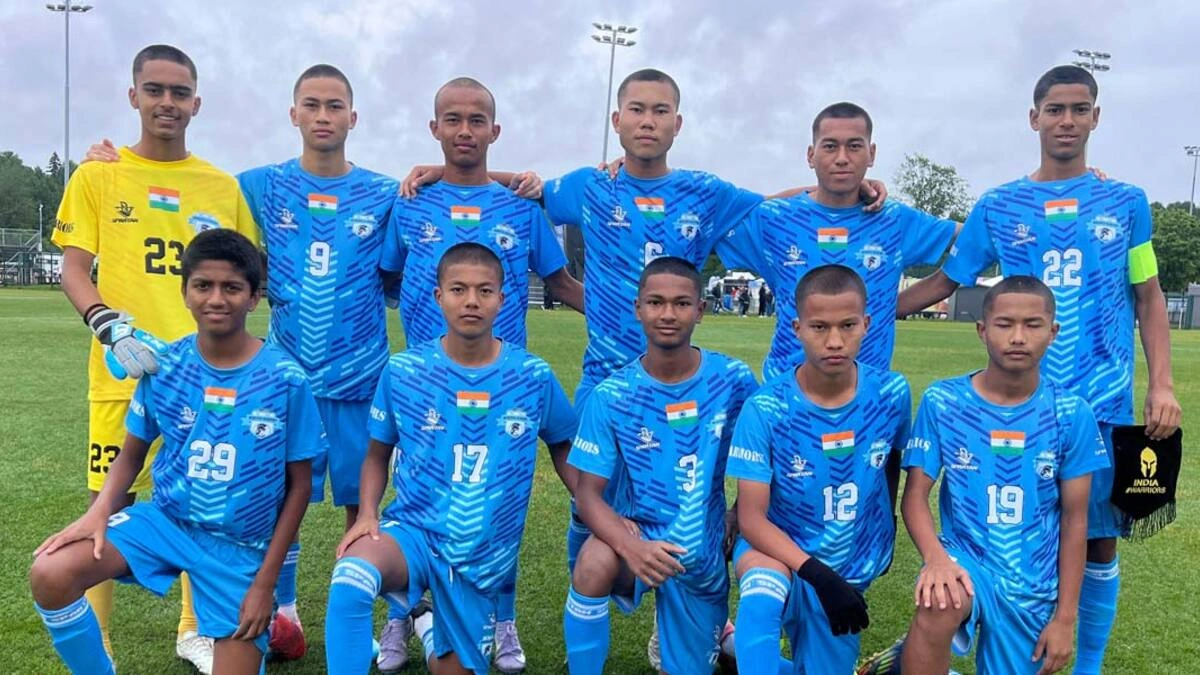
The world of youth football witnessed a massive shift this week in Spain. Minerva Academy, known as The Factory in Mohali, Punjab, has officially arrived on the global stage. Their journey at the 2026 Mediterranean International Cup (MIC) was nothing short of legendary. It began with a historic 6-0 demolition of the mighty Liverpool FC, a result that proved Indian talent can outclass the best in Europe.
While the journey ended today with a narrow 2-1 loss in the Quarter-finals to Spanish side UE Figueres, the defeat felt more like a “heroic stand” than a failure. The Warriors fought until the final whistle, matching the Spanish elite in every department. However, the exit leaves a bitter taste for many fans.
A controversial late penalty awarded to the home side decided the match, raising a serious question: Was the dream of the Indian youngsters cut short by a questionable officiating call? Regardless of that single whistle, Minerva returns home with the respect of the footballing world.
1. The 2026 MIC Cup: A Historic Global Statement
The MIC Cup is the most famous youth tournament in the world. Stars like Lionel Messi and Neymar started their journeys here. In 2026, Minerva Academy didn’t just show up to play; they showed up to dominate.
The 6-0 Destruction of Liverpool
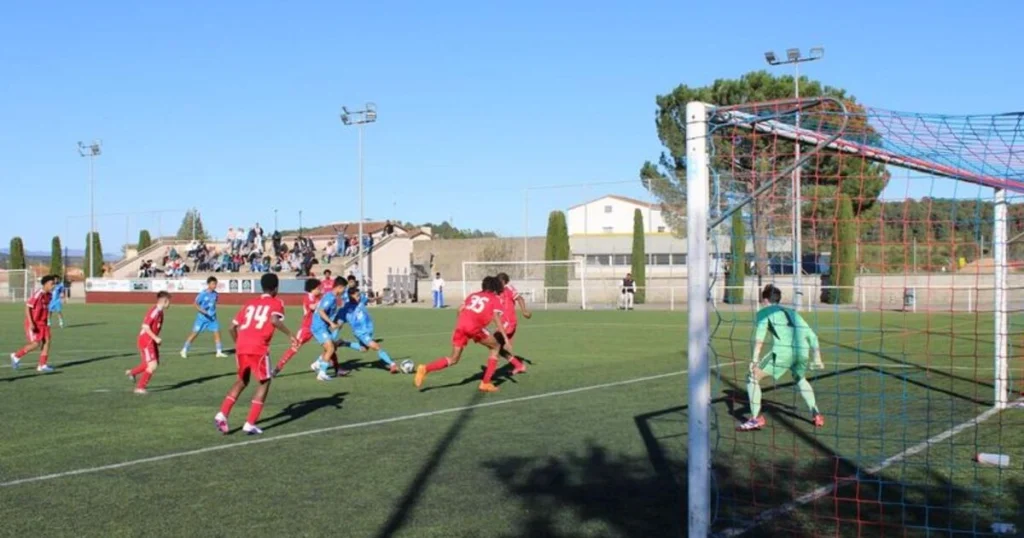
On April 3, 2026, Minerva did the impossible. They faced Liverpool’s elite U15 academy, a team with world-class facilities and millions in funding. Minerva didn’t just win; they dismantled them.
Using a lockdown press, they forced Liverpool into constant mistakes.
- Wahengbam Raj Singh was unstoppable, scoring a hat trick.
- Mohammad Azam Khan added two goals.
- Lisham Amarson Singh finished the rout with a clinical sixth goal.
| Match Phase | What Happened | Player Impact |
| 0′ to 15′ | Early Strike | Raj Singh’s clinical finishing made it 6-0. |
| 20′ to 45′ | Midfield Control | Azam Khan dictated the pace of the game. |
| 50′ to 70′ | The Hat-trick | Raj Singh clinical finishing made it 6-0. |
The Quarter-Final Heartbreak
Just 24 hours after beating Liverpool, Minerva faced UE Figueres. The match was a tactical battle, locked at 1-1 at halftime. Minerva looked like the stronger side, but a late, highly debated penalty gave the Spanish team the 2-1 win. Despite the loss, Minerva is the first Indian team to ever reach the MIC Quarter-finals.
The Historical Foundations of the Mohali Factory
The trajectory of Minerva Academy from a local amateur club to an international powerhouse is a study in relentless specialization. Founded in 2005, the academy initially served as a revival project for the Minerva Club of the Minerva Public School in Mohali.
For the first eight years of its existence, it operated as an amateur six-a-side team, appearing primarily in local age-grouped tournaments. The critical pivot occurred in 2013, when owner Ranjit Bajaj shifted the focus to a professional residential model, which eventually led to the club’s entry into the I-League 2nd Division in 2015.
The branding evolution from Minerva Academy to Minerva Punjab FC, and later to Punjab FC, mirrored its growing ambitions. However, a significant ideological divergence occurred in 2019-2020. Following the sale of the professional senior team to RoundGlass Sports, Bajaj retained the academy’s identity, choosing to divest from the traditional senior league system to reinvest all resources into a ruthless talent factory.
This move allowed the academy to bypass the often-stagnant domestic professional pipeline, focusing instead on intensive, isolated development designed to produce players capable of competing in Europe.
Domestic Hegemony: A Statistical Profile
Minerva’s domestic performance is defined by a level of dominance that remains unprecedented in the history of the All India Football Federation (AIFF). The 2017-2018 season stands as the ultimate benchmark, where the institution became the only Indian club to win the U13, U15, U18, and senior I-League national titles in a single calendar year.
The U15 side has consistently used the AIFF Junior Leagues not merely as a competition but also as a testing ground for offensive tactical innovations. In the 2023-2024 season, the squad achieved “invincible” status, scoring 127 goals in just 11 matches.
The statistical anomaly of their performance was highlighted on March 31, 2024, when the team recorded a 33-1 victory over Namdhari Academy, the largest margin of victory in the history of the AIFF Sub-Junior League.
| Season | League/Tournament | Category | Achievement | Statistical Highlight |
| 2017-18 | I-League (Senior) | Senior | Champions | First North Indian champion since 1996. |
| 2017-18 | AIFF Youth Leagues | U13, U15, U18 | Triple Champions | Only club to win all national youth titles in one year. |
| 2018-19 | U15 I-League | U15 | Champions | Fourth title in five years. |
| 2023-24 | Sub-Junior League | U13/U14 | Invincible Champions | 127 goals in 11 matches; 33-1 record win. |
| 2024-25 | AIFF Junior League | U15 | Runners-up | Highest scoring side; lost 1-0 in final vs Punjab FC. |
| 2025 | Subroto Cup | U17 | Champions | 6-0 win vs Bihar in the final. |
Mission World Cup 2034: Scaling the International Stage
The transition from domestic success to global recognition was catalyzed by the “World Cup Batch 2034” mission. This strategic initiative involves scouting the top talent from across 10 Indian states and providing them with full scholarships to live and train in a high-intensity environment. The ultimate objective of this program is to ensure that, by the 2034 FIFA World Cup, India has a core of players battle-hardened by international competition from a young age.
The Gothia Cup and the Treble Campaign
In July 2023, Minerva made history by becoming the first Indian team to win the Gothia Cup (World Youth Cup) in Sweden. Facing Brazil’s Ordin FC in the final, the “Warriors” displayed a level of tactical maturity and early-match intensity that overwhelmed the South American side, scoring two goals within the first five minutes. The 3-1 victory served as a proof-of-concept for Bajaj’s philosophy: that Indian players, given proper structure and discipline, could outmatch the best in the world.
The momentum reached a zenith in 2025, a year that Ranjit Bajaj describes as a transformative period for Indian footballing reputation. Minerva Academy achieved an unprecedented “European Treble,” winning three of the most competitive youth tournaments on the planet within a single season:
- Gothia Cup (Sweden): Secured a second historic title, proving the 2023 victory was a result of a system rather than a fluke.
- Dana Cup (Denmark): Defeated Maltese side KFF Club 15-0 in the final. Across seven matches, the team scored 110 goals and conceded only one.
- Norway Cup (Norway): In the tournament’s 2025 edition, Minerva scored 130 goals in eight matches, the highest across all 33 age categories.
The statistical breakdown of the Norway Cup campaign illustrates a terrifying level of efficiency. The group stage saw victories of 25-0, 15-0, and 22-0. In the knockout stages, they dismantled Roselands BK 11-0 and Åmdal-Tokke FK 17-0. The semi-final against Palestine’s Ramthael Chareef Club was the only match where the scoreline reflected a contest, yet Minerva still prevailed to take the title.
| Tournament (2025) | Matches | Goals For (GF) | Goals Against (GA) | Top Performer |
| Gothia Cup | 7 | 42 | 3 | Wahengbam Raj Singh. |
| Dana Cup | 7 | 110 | 1 | Lisham Amarson Singh. |
| Norway Cup | 8 | 130 | 1 | Wahengbam Raj Singh (60 goals total in Europe). |
| Mina Cup (2022) | 6 | 28 | 2 | Historic first win in UAE. |
The 2026 Mediterranean International Cup (MIC): Tournament Context and Significance
The Mediterranean International Cup (MIC Football) is widely regarded as the most elite youth tournament in the world. Hosted annually in Costa Brava, Catalonia, during Easter, it serves as the ultimate showcase for the next generation of footballing icons. For 2026, the 24th edition of the tournament reached record participation with over 444 teams representing 44 countries.
The MIC Heritage: A Cradle for Legends
The MIC’s prestige is rooted in its ability to predict future stardom. Players who once competed in the youth categories at MIC include Lionel Messi (2003), Neymar Jr (2008), Rodri, Pedri, and Lamine Yamal. The 2026 tournament featured world-renowned academies from Real Madrid, Liverpool, Manchester United, AC Milan, Ajax, and Shakhtar Donetsk.
Minerva Academy’s participation in the 2026 edition was a historic first for India. Their seeding as a top team in Group B was a direct acknowledgment of their “European Treble” in 2025 and their rising reputation among elite scouts. To ensure they arrived as contenders rather than “tourists,” the academy launched a ₹1 Crore crowdfunding campaign to fund a high-intensity preparatory camp in Spain, allowing the players to acclimate to European tempo, officiating standards, and climate.
MIC Cup 2026 Category and Group Structure
The U15 category at the 2026 MIC Cup consisted of 56 teams divided into 14 groups. The competition format is notoriously ruthless, with only the top two teams from each group advancing to the final knockout round, while the remainder are relegated to a consolidation phase.
Group B Composition (U15):
- Minerva Academy FC (India) – Seeded 1.
- BOCA OC (USA) – A premier North American academy.
- EF Santa Ana (Canada) – Known for disciplined tactical structures.
- Kaptiva Sports Academy (Spain) – A local Catalan elite residency program.
The 2026 Campaign: Tactical Analysis and The Liverpool Result
Minerva Academy’s performance in Spain during the 2026 MIC Cup has been described as a “masterclass” in youth footballing efficiency. The U15 “Warriors” began their campaign by navigating a difficult Group B, which required them to adapt to different regional styles.
The Group Stage and Early Knockouts
Minerva’s tactical identity is built on a high-pressing, transition-heavy system designed by Technical Director Surinder Singh and monitored by Ranjit Bajaj. They opened the tournament with a 4-1 victory over America’s BOCA OC, followed by a 3-0 win against Kaptiva Sports Academy. The final group match against Canada’s EF Santa Ana was a cagey 1-0 win, which secured Minerva’s position at the top of the group with a perfect record.
In the Round of 32, Minerva faced another Canadian side, CS Braves. The match was defined by the individual brilliance of the forward line, with Wahengbam Raj Singh, Konthoujam Chetan Singh, and Thokchom Chingkheinganba Singh all contributing to a 3-0 victory. This result set up one of the most anticipated Round of 16 fixtures in the tournament’s history: Minerva Academy vs. Liverpool FC.
The 6-0 Triumph Over Liverpool FC
On April 3, 2026, Minerva Academy delivered a result that stunned the global youth football community. Facing Liverpool’s elite U15 academy side, a team backed by multi-million dollar infrastructure, Minerva did not merely compete; they dismantled them.
The 6-0 victory was characterized by a high-intensity “lockdown” press that Liverpool’s defenders found impossible to bypass. Wahengbam Raj Singh emerged as the protagonist of the day, netting a hat-trick that capitalized on Liverpool’s inability to cope with Minerva’s pace of transition. Mohammad Azam Khan added a brace, and Lisham Amarson Singh capped the scoring with a clinical sixth goal.
| Match Phase | Event | Player Impact | Tactical Implication |
| 0′-15′ | Early Goal Blitz | Raj Singh. | High press forced three defensive turnovers in the final third. |
| 20′-45′ | Midfield Dominance | Azam Khan. | Controlled the tempo; Liverpool struggled with the climate and pace. |
| 50′-70′ | Clinical Finishing | Raj Singh (Hat-trick). | Exposed Liverpool’s high line with direct vertical passing. |
| 80′-90′ | Final Strike | Amarson Singh. | Demonstrated superior physical conditioning late in the match. |
The significance of this result cannot be overstated. For an Indian academy to defeat a top-tier Premier League academy by six goals on European soil signifies a shift in the global talent hierarchy. It validates the Blue Lock residential model, proving that intensive, isolated training under a unified philosophy can produce technical parity with Europe’s best.
The “Blue Lock” Methodology: Training, Residency, and Discipline
The success of the U15 side is the direct result of a total immersion environment at the Mohali campus. This model has been compared to the Blue Lock project, a fictional, ruthless talent factory, because of its isolationist approach and singular focus on elite performance.
The Residential Ecosystem
The Minerva Academy campus spans 10 acres and is designed to provide everything a modern footballer requires for professional development. Players live in an on-site hostel that ensures standardized nutrition and recovery, with a mess that operates on a no-profit, no-loss basis, serving balanced meals five times a day.
The daily routine is intensive, emphasizing both mental and physical fortitude. The curriculum is designed to prepare players for the mental rigors of five-day testing and international travel. While the academy is also known for its SSB (Services Selection Board) training, the footballing division shares the same culture of unwavering dedication and state-of-the-art facilities.
Daily Residential Schedule (Footballing Model)
| Time | Activity | Purpose |
| 06:15 – 07:45 | Breakfast and Nutrition | High-protein intake for morning training. |
| 08:00 – 11:00 | On-Field Tactical Session | Focus on team movement, pressing, and game scenarios. |
| 11:00 – 11:15 | Mid-Morning Recovery | Hydration and tactical theory discussion. |
| 13:00 – 14:15 | Lunch and Rest | Compulsory recovery period for physical maintenance. |
| 15:30 – 18:30 | Evening Technical Session | Individual skill drills, speed, and agility training. |
| 19:30 – 21:00 | Dinner and Mental Prep | Reviewing match footage; fostering team spirit. |
Coaching Excellence: The 1,000 Certified Coaches Milestone
Minerva Academy’s influence extends beyond its players to the coaching fraternity of India. The academy has produced over 1,000 certified coaches who are trained in the Minerva Philosophy of hard work, tactical intelligence, and victory. This standardized coaching curriculum ensures that, even as new players enter the U15 program, the team’s tactical DNA remains consistent.
The coaching philosophy is holistic, viewing player development as an intersection of strategic, technical, and psychological growth. Coaches are taught to be mentors and leaders, equipping them with tools to handle the pressures of international tournaments like the MIC Cup.
Professional Pathways and National Impact
The ultimate metric of an academy’s success is its ability to transition players into professional leagues and the national team. Minerva Academy has produced more than 250 players for India’s various national teams, from U13 to the senior squad.
Alumni and Market Valuation
The “World Cup Batch” players are already seeing their market values rise on platforms like Transfermarkt. Notable alumni include Jeakson Singh, the defensive midfielder who scored India’s first-ever goal in a FIFA World Cup (U-17 World Cup 2017), and Vikram Partap Singh, a prolific winger in the Indian Super League (ISL).
| Player | Position | Born | Market Value (Approx.) | Career Highlight |
| Anwar Ali | Centre-Back | 2000 | €275k | Key starter for the Indian Senior National Team. |
| Tekcham Abhishek Singh | Left-Back | 2005 | €225k | Emerging star in professional domestic leagues. |
| Jeakson Singh | Def. Midfield | 2001 | €200k | First Indian goalscorer in a FIFA World Cup. |
| Vikram Partap Singh | Right Winger | 2002 | €200k | Elite attacker for Mumbai City FC in ISL. |
| Moirangthem Thoiba | Centre-Back | 2002 | €200k | Youngest goalscorer in AFC Cup history (16y 154d). |
| Bikash Yumnam | Centre-Back | 2003 | €200k | Highly sought-after modern ball-playing defender. |
Felicitations by Legends
The 2025 “European Treble” brought global recognition, culminating in a historic felicitation ceremony in Delhi. The Minerva U15 champions were honored by Lionel Messi, Luis Suárez, and Rodrigo De Paul. Messi personally recognized the achievement of winning the Gothia, Dana, and Norway Cups in a single season, a moment Ranjit Bajaj described as a “profound acknowledgment of Indian football’s potential by the greatest player to ever grace the game”.
The Future of the World Cup Batch 2034
The success of the Minerva U15 side is a strategic pilot for the future of Indian football. The institution remains steadfast in its mission to build a comprehensive football ecosystem, focusing on players capable of competing at the highest global level. The current World Cup Batch 2034 players, such as Azlaan Shah and Moosa Ashiq Sofi, are already transitioning successfully into elite domestic environments after dominating youth tournaments in Europe and Asia.
Strategic Recommendations for Youth Development
To maintain this momentum, the report identifies several critical emerging trends in Indian scouting and development:
- Intent-Driven Scouting: Shifting from volume scouting to merit-based evaluation across regional groups.
- Increased International Exposure: Regular participation in elite tournaments like the MIC Cup and Gothia Cup is essential to harden youth players against the psychological pressures of top-tier football.
- Infrastructure Excellence: Developing centers of excellence in every state that replicate the Minerva residential lockdown model.
- Technological Integration: Utilizing data analytics and virtual reality tools to monitor performance and refine tactical understanding.
The Minerva Academy U15 program has successfully redefined the ceiling for Indian youth football. Through the 2025 European Treble and the 2026 MIC Cup campaign, most notably the historic 6-0 dismantling of Liverpool FC, the academy has provided a repeatable blueprint for success.
By combining a residential Blue Lock environment with rigorous international exposure and a long-term developmental vision directed toward 2034, Minerva has transitioned from a domestic powerhouse into a globally respected entity. The Factory in Mohali is no longer just producing players; it is forging the professional standard that will define Indian football on the world stage over the next two decades.
FAQs: Minerva Academy’s Historic Run
Q. How did an Indian academy beat a giant like Liverpool 6-0?
A. It came down to a “lockdown” high-pressure system and superior fitness. While Liverpool has more money, Minerva’s players live in a high-intensity “Blue Lock” residential environment where they train like pros year-round. This allowed them to overwhelm the English side with speed and teamwork, led by Wahengbam Raj Singh’s hat trick.
Q. Why was the Quarter-final loss to UE Figueres controversial?
A. The match was a tight 1-1 battle until the final minutes when the referee awarded a highly debated penalty to the Spanish home team. Many fans and observers felt the call was soft or incorrect, unfairly ending Minerva’s dream run after they had outplayed their opponents for much of the game.
Q. What makes the “World Cup Batch 2034” so special?
A. This is a long-term mission by owner Ranjit Bajaj to prepare India for the 2034 FIFA World Cup. Instead of just playing locally, these players are sent to elite European tournaments (like the MIC and Gothia Cup) to gain “battle-hardened” experience against the world’s best, ensuring they won’t be intimidated by big stages in the future.