
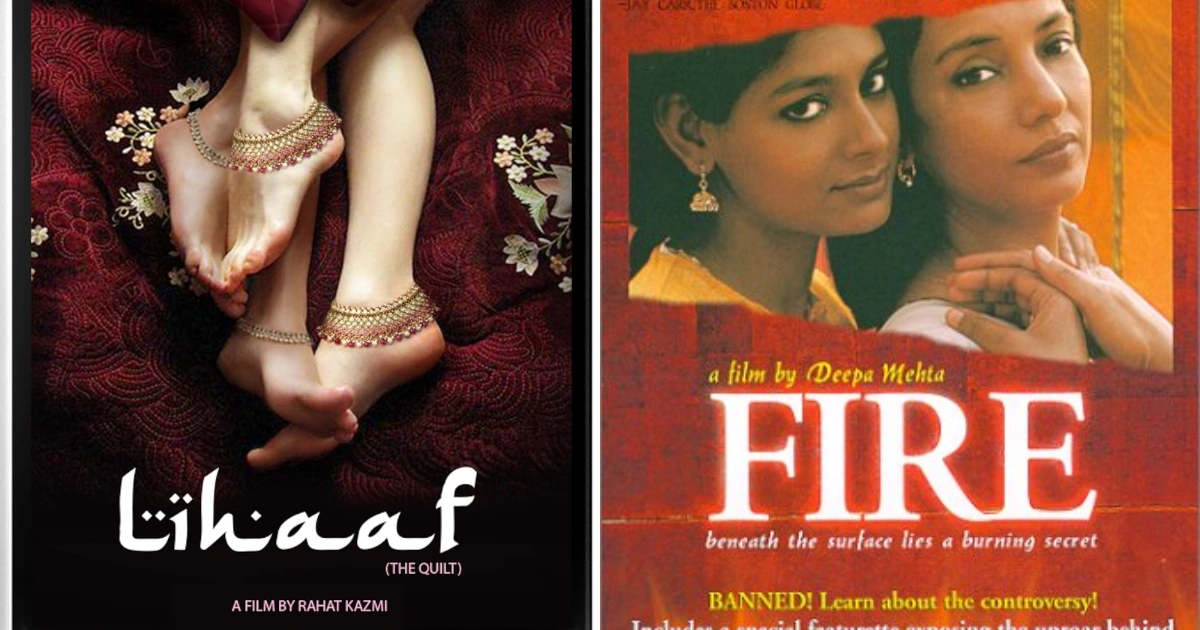
When Deepa Mehta released her controversial film Fire in 1996, it ignited intense civil and political backlash across India. Demonstrators attacked cinema halls, vandalized posters, and demanded blanket bans.
Protesters claimed that depicting a romantic and physical relationship between two women in a traditional Hindu household dishonored sacred religious iconography and violated Indian cultural norms.
Yet, behind the political storm surrounding the names Radha and Sita lies a deeper literary reality: the narrative backbone of Fire traces directly back to a 1942 Urdu short story written by a Muslim woman, featuring two Muslim protagonists.
The Origin: Ismat Chughtai’s Lihaaf (1942)
Five decades before Bollywood brought female same-sex desire to mainstream cinema, legendary Urdu writer Ismat Chughtai published Lihaaf (“The Quilt”) in the Lahore-based literary journal Adab-i-Latif.
Set inside a feudal Muslim household, the narrative centers on two women:
- Begum Jaan: A wealthy woman trapped in severe emotional isolation and neglect due to her husband’s indifference.
- Rabbo: Begum Jaan’s masseuse and companion, who provides her with warmth, emotional solace, and physical intimacy.
Narrated through the observational eyes of a young girl visiting the house, Lihaaf used metaphor and shadow play beneath a heavy quilt to depict female intimacy.
The story created an immediate scandal. In 1944, the British Indian administration charged Chughtai with obscenity. She contested the charges in a Lahore court and was acquitted after the judge concluded that the text contained no explicitly vulgar words, relying entirely on literary suggestion.
The Adaptation: Deepa Mehta’s Fire (1996)
When Deepa Mehta wrote and directed Fire, the relational structure between the two lead characters directly mirrored Lihaaf:
- A neglected, isolated woman stuck in an unfulfilling marriage with a distant husband.
- A second woman entering the joint family unit who becomes her romantic partner and emotional ally.
- A domestic space where shared confinement evolves into solidarity and love.
However, Mehta altered the socio-religious framework. Rather than retaining the Muslim identities of Begum Jaan and Rabbo, the screenplay transposed the story into a middle-class Hindu family operating a video rental and snack store in New Delhi.
The protagonists were given names directly tied to sacred Hindu traditions:
- Radha (played by Shabana Azmi): Named after the revered companion of Lord Krishna.
- Sita (played by Nandita Das): Named after the central figure of the Ramayana.
Cultural Erasure and the Changing Narrative
The decision to replace Begum Jaan and Rabbo with Radha and Sita shifted both the reception and the literary heritage of the story:
1. Subverting Traditional Symbols
Using the names Radha and Sita allowed the film to critique patriarchal family structures in contemporary India. Characters named after figures associated with marital devotion and sacrifice were re-imagined as women making conscious choices for individual freedom and personal desire.
2. Disconnecting from Urdu Literary History
While this character renaming heightened the social critique for mainstream audiences, it simultaneously obscured the film’s roots in 20th-century Urdu feminist literature. For viewers unfamiliar with Ismat Chughtai’s oeuvre, Fire appeared to be an entirely original, modern phenomenon rather than a story pioneered by a Muslim woman fifty years prior.
Parallel Patterns in Mainstream Storytelling
This pattern of rewriting, renaming, or recontextualizing stories rooted in specific cultural backgrounds is not isolated to Fire. Similar structural choices appear across different eras of Hindi cinema.
Selective Adaptations of Classical Tropes
- Classical Punjabi and Urdu Sufi narratives (such as Heer Ranjha or Anarkali), originally grounded in historical Muslim socio-cultural settings, are frequently stripped of their specific spiritual and regional frameworks when adapted into generalized commercial romances.
Dramatic Asymmetries in Classic Cinema
- In 1970s and 1980s cinema, such as Salim-Javed’s scripts for Deewaar (1975) and Manmohan Desai’s Coolie (1983), protagonists often navigated divine protection through distinct symbolic choices. In Deewaar, the anti-hero Vijay explicitly rejects his mother’s Hindu temple, standing outside in rebellion, yet his life is repeatedly saved from bullets by carrying Billa No. 786 (an emblem bearing the sacred Islamic numerical combination) in his shirt pocket. The narrative grants physical protection through a Muslim talisman while maintaining a stance of tragic defiance toward traditional temple spaces until the final climax.
How Chak De! India Connects to the Overall Theme
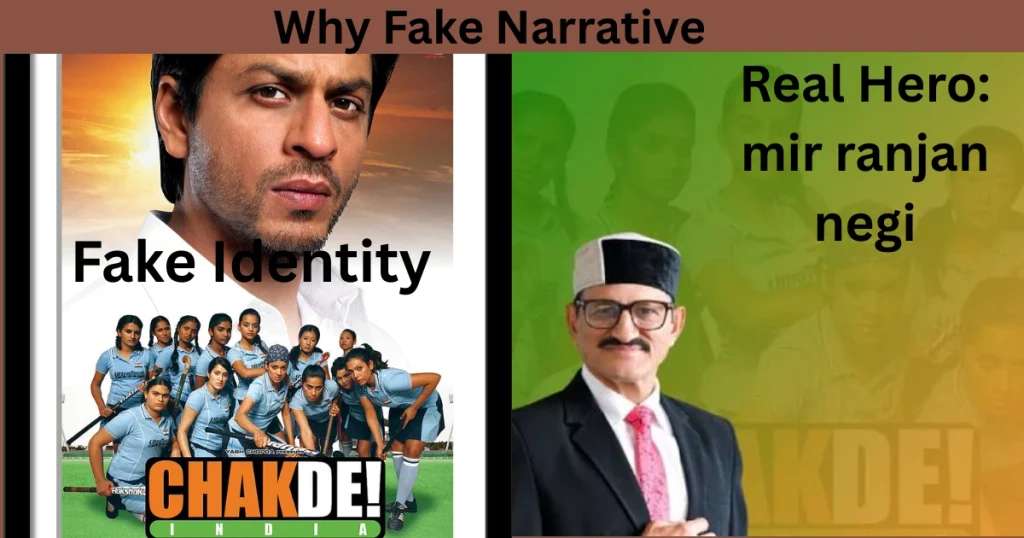
When placed alongside earlier examples, Chak De! India completes a striking pattern across Indian entertainment media:
- In Fire (1996): A story rooted in Muslim feminist literature (Lihaaf featuring Begum Jaan and Rabbo) was retitled using Hindu sacred names (Radha and Sita) to frame a modern, anti-patriarchal critique.
- In Classic Cinema (Deewaar, Coolie): Protagonists defied traditional Hindu temples while deriving physical, divine protection from Islamic symbols like Billa No. 786.
- In Chak De! India (2007): A real-life victory achieved by a Hindu coach (Mir Ranjan Negi) was rewritten under a Muslim protagonist (Kabir Khan) to build a dramatic narrative around religious identity and patriotism.
Whether through literary retitling, selective character changes, or altered real-life biopics, these choices demonstrate how Bollywood frequently manipulates religious and cultural identities, sometimes replacing Muslim roots with Hindu names, and other times replacing real-life Hindu figures with Muslim characters, to serve commercial tropes or specific political commentary.